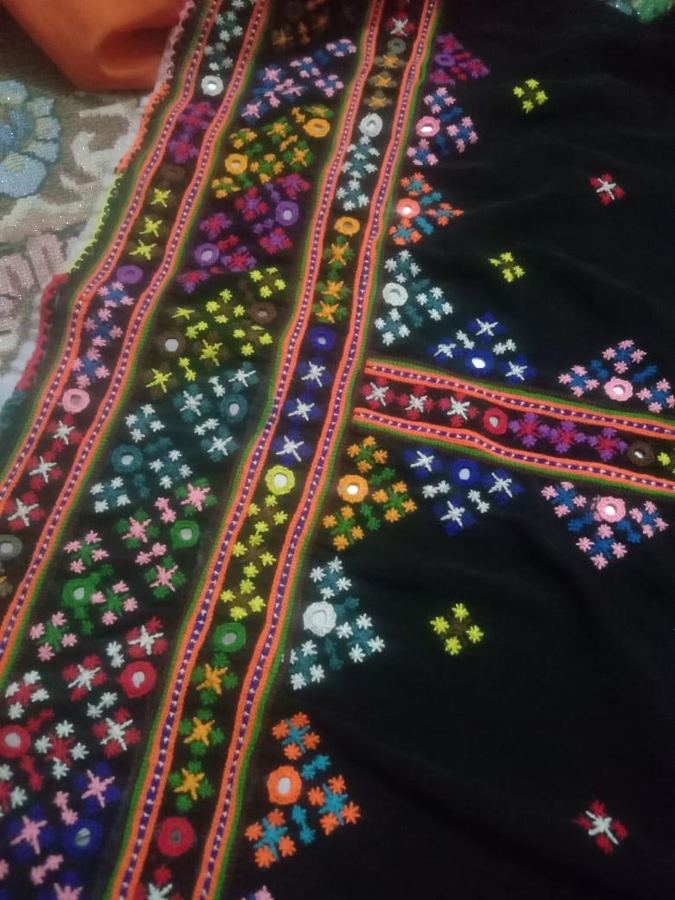
The traditional Sindhi dress for women is a shirt (cholo or kurti) with a richly embroidered chest panel full of tiny mirrors, worn with a shalwar and a dupatta or ajrak. Men wear shalwar kameez with an ajrak shawl and an embroidered, mirror-work Sindhi topi. Mirror work is the signature of Sindhi embroidery.
Sindhi dress for women
The traditional women's dress of Sindh is built around one heavily embroidered piece: the chest panel of the shirt. It is often covered from neck to waist with mirror work, chain stitch, and sometimes sequins, beads, shells or tassels. The style of the panel can show which area or community a woman comes from, and mothers traditionally teach their daughters their family's patterns.
- Shirt (cholo or kurti): with an embroidered, mirror-work front panel and sleeves.
- Shalwar or suthan: loose trousers, often in a matching or contrasting colour.
- Dupatta or ajrak: an embroidered dupatta, or an ajrak-print one for culture events.
Sindhi embroidery and mirror work
Mirror work (shisha) is what most people mean by Sindhi embroidery. Small round mirrors are held in place by a ring of buttonhole stitches, then surrounded by flowers, stars and paisleys in chain stitch and satin stitch.
- Chain stitch and satin stitch for outlines and filled motifs.
- Appliqué and patchwork, the same technique used in Sindhi ralli quilts.
- Gold and silver thread for wedding wear.
Mirror work is shared with Balochi embroidery, where it sits beside the fine geometric doch stitch. Compare them on our Balochi embroidery guide.
Sindhi kurti designs
The Sindhi kurti is the most popular way to wear Sindhi embroidery today. Common designs:
- Mirror-work neckline: embroidery around the neck and down the front placket. Simple, and good for daily wear and university.
- Full yoke: a large embroidered chest panel in the traditional style, for Eid and events.
- Embroidered sleeves and hem to match the neckline.
- Sindhi karhai on plain fabric: black, maroon, white or mustard grounds make the thread colours stand out.
Ajrak and the Sindhi topi
The ajrak is a block-printed cloth with geometric patterns, traditionally dyed with madder red and indigo. It is worn as a shawl or turban, used as a dupatta, and given to guests as a sign of respect. The Sindhi topi is a round cap covered in embroidery and small mirrors, with a cut-out at the front.
Both are worn with pride on Sindhi Culture Day (Sindhi Topi and Ajrak Day), celebrated in early December, usually on the first Sunday.
Sindhi dress for men and boys
Men and boys usually wear a white or light shalwar kameez with an ajrak over the shoulder and a Sindhi topi. For weddings, an embroidered waistcoat is often added.
Sindhi culture dress for girls and kids
For a school culture day or Sindhi Culture Day:
- Girls: a mirror-work kurti or frock with a plain shalwar and an ajrak-print dupatta. Add bangles for a complete look.
- Boys: a white shalwar kameez, an ajrak over the shoulder and a Sindhi topi.
- Baby girls: a small mirror-work frock is easiest to wear.
Dressing children from other provinces too? See all culture day dress ideas.
Ordering a Sindhi style dress
Balochify's speciality is Balochi embroidery, and our artisans also do mirror work. If you want a Sindhi-style kurti or dress, send us a picture of the style you like. We tell you honestly whether we can make it, and the price and time. We take orders from Pakistan, the UAE, Oman and Saudi Arabia.
Questions
What is the traditional dress of Sindh?
Women traditionally wear a shirt (cholo or kurti) with a heavily embroidered, mirror-work chest panel, with a shalwar and a dupatta or ajrak. Men wear shalwar kameez with an ajrak shawl and an embroidered Sindhi topi.
What is Sindhi embroidery known for?
Mirror work: small mirrors stitched down with buttonhole stitches inside colourful chain and satin stitch motifs. Each community and area of Sindh has its own style.
What is an ajrak?
An ajrak is a block-printed cloth from Sindh with geometric patterns, traditionally dyed with madder red and indigo. It is worn as a shawl or turban and given as a sign of respect.
When is Sindhi Culture Day?
Sindhi Culture Day, also called Sindhi Topi and Ajrak Day, is celebrated in early December, usually on the first Sunday.
Can Balochify make a Sindhi style dress?
Send a picture of the Sindhi kurti or mirror-work style you want. We tell you whether our artisans can make it, and the price and time.
Want a mirror-work dress?
Send us a picture of the style. We reply with what we can make, the price and the time.
Explore more cultures
Balochi dress
Hand-embroidered designs for women, girls and kids. Our speciality.
Read →Punjabi dress
Phulkari dupatta, Punjabi suit, kurta and lacha.
Read →Pashtun dress
Pathani dress, the khat and kuchi-style embroidery.
Read →Hazaragi dress
Long Hazara dresses with fine cross-stitch embroidery.
Read →Kashmiri dress
The pheran, with tilla and aari embroidery.
Read →All Pakistani cultural dresses
Names by province and culture day ideas.
Read →